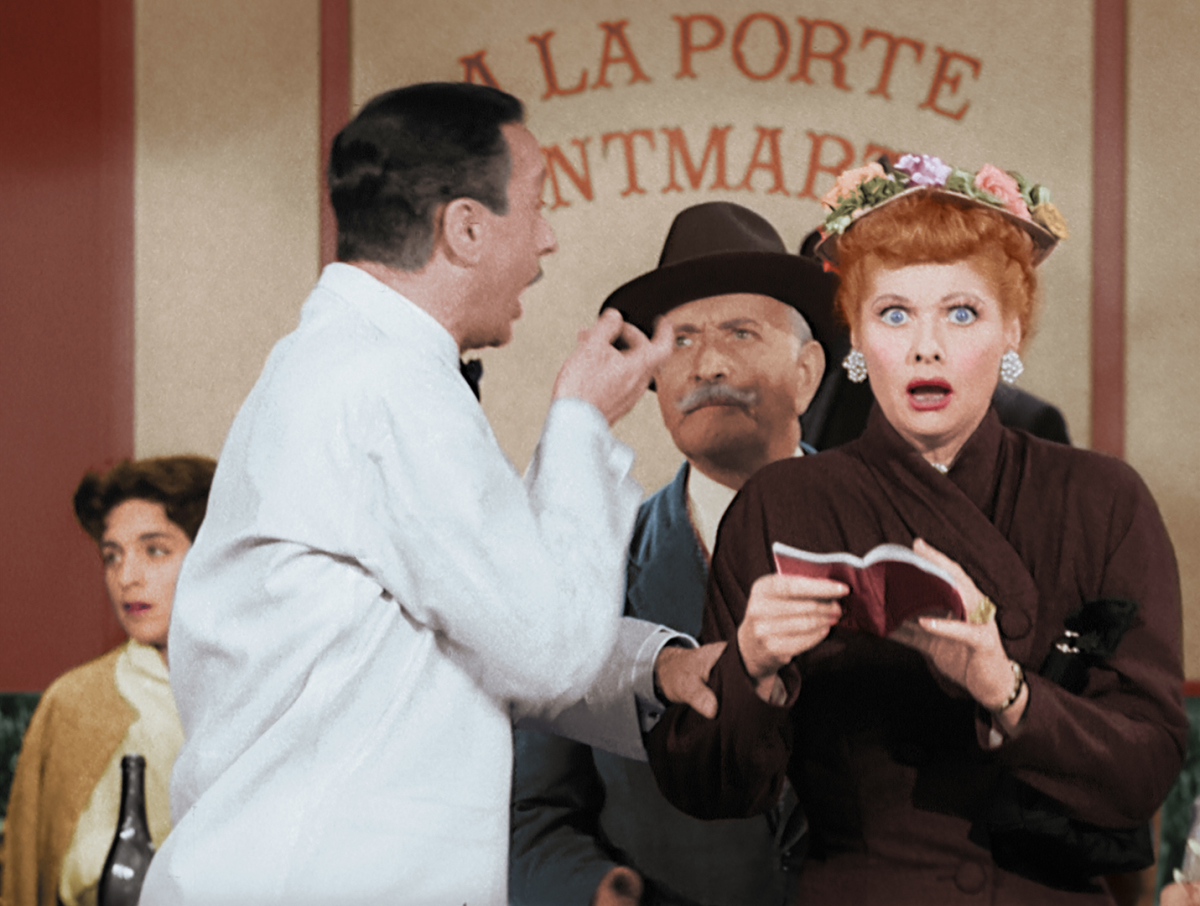
(Portions of this are excerpted from “Television, and How It Got That Way,” a book-in-process. I’m running it now, because of an “I Love Lucy” profile airing at 8 p.m. Monday, Oct. 13, on CW. For the almost-complete book, click “The Book,” on the right side of the home page.)
To ponder the miracle of “I Love Lucy,” consider the void around it.
This was 1951, when TV was young and wobbly. There were a few worthy shows — Sid Caesar, Ed Sullivan, live dramas — and a lot of others.
In a week of primetime shows that fall, you’d find wrestling (twice) and boxing (twice). You’d find “Georgetown University Forum” and “Johns Hopkins Science Review, “Youth on the March” and “American Youth Forum,” plus “Film Filler” and “Lessons in Safety.”
Into that shaky field came the “Lucy” show. “It should bounce to the top of the ratings heap,” a Hollywood Reporter critic wrote.
It did. On a typical Monday that first season, half of all TV homes watched “I Love Lucy.” In the second season, that was two-thirds; the night Lucy had her baby, that hit 71.7 percent.
It’s easy to attribute all of this to Ball and Desi Arnaz, her husband and co-star. The Oct. 13 special (launching a “TV We Love” series on CW) sort of does that. Arnaz is often credited with inventing the system of filming in front of a live audience. In truth, he merely improved it, out of necessity.
Ball was already doing a character a lot like this, on a radio show called “My Favorite Husband.” The radio scripts came from Madelyn Pugh and Bob Carroll Jr., the producer was Jess Oppenheimer and Ball did the rest.
“Unexpected qualities appeared out of nowhere,” Oppenheimer wrote in “Laughs, Luck … and Lucy” (Syracuse Press, 1996). “Little, human … inflections that were exactly what your sister or your mother or the lady bus driver used. She was the everywoman.”
But she needed a crowd. “Lucy was dreadful without an audience,” CBS executive Harry Ackerman once said. “She absolutely bloomed in front of an audience.”
The TV show needed to be cone in front of people. It needed the “multi-camera” method: Do it like a play, but with three or four cameras recording.
Arnaz didn’t invent the method, Oppenheimer wrote. “It developed in conferences and was was dictated by necessity.”
Hollywood had been doing some multi-cam since the late 1920s. In the late ’40s, that was tried on TV, Coyne Steven Sanders and Tom Gilbert wrote in “Desilu” (Morrow, 1993). Shows included “Public Prosecutor,” “Silver Theater” and “Truth or Consequences.”
But the “multi-cam”approach had only been tried in one comedy, “Amos and Andy,” and that was a modified version: Film the show without an audience, then show the result to people, to get a laugh track.
That, Oppenheier wrote, missed the key step of esponding to an audience. “There is that quality, that response, that comes only from a live experience. And the American audience had learned to expect this, after 25 years of listening to studio audiences laughing on radio.”
Arnaz did add two key steps. He:
— Brought in a Hollywood lighting expert, to set things up.
— And insisted on using film, so it could be shot in Hollywood and then sent to New York. CBS balked at the expense; so a deal was cut: Ball and Arnaz would take a pay cut … if they owned the episodes afterward.
That became the birth of the rerun world. And those reruns financed the growth of the Desilu company. Desilu produced “Star Trek,” “Mannix,” “The Untouchables,” “Mission:Impossible” and more. It also rented out stages for other shows — many of them comedies using that multi-cam approach.
Those reruns were valuable because the show was so funny. Pugh and Carroll came up with the ideas; Oppenheimer wrote and registered the basic concept:
Ricky, his concept said, “was raised in show business, sees none of its glamour, only its deficiencies, and yearns to ba an ordinary citizen.”
He married a Midwesterner who was accustomed to the ordinary. But to her, “show business is the most glamorous field in the world.”
That became the root for the makeshift pilot film — Lucy disguises herself to join Ricky’s act — and many others episodes, from grape-stomping to vitamin commercials to, eventually, moving to Hollywood.
Scripts poured out quickly. Much later, Roseanne Barr (doing 22 episodes a year) had 20 or more writers; “Lucy” (averaging 30 episodes) had two writers, eventually adding a third.
But these scripts smartly took us to the points where Ball could work her sight-gag magic.
That’s what we see in the Oct. 13 show: Yes, it gets candy-coated at times, crediting Ball and Arnaz for everything. But it also delights us with a flurry of clips and sight gats.
Viewed 70 years later, these remain hilarious. Viewed in the era of “Film Filler” and “Lessons in Safety,” they seemed miraculous.