A dozen years ago, Scottish actors were buzzing about the odd project that was consuming their film industry.
“It just arrived in force and it absorbed about 85 percent of our television crew,” Richard Rankin said.
This was “Outlander” (shown here) now a familiar show — its eighth and final season starts Friday -(March 6) — but then an oddity. Its time-travel story sweeps across two centuries of adventure and romance; working in it was a logical goal for Scotsmen and others.
Sophie Skelton, who’s English, auditioned for the role of Brianna, then was disappointed. “I didn’t hear anything for a year,” she told the Television Critics Association. “I didn’t want to watch the show, ’cause I didn’t want to see who’d gotten” the role.”
Then she learned the details: Brianna wasn’t going to arrive until the end of the second season; Skelton got the role, playing a gorgeous redhead who was time-traveling with her mom (Claire), while her dad was fighting in 18th-century Scotland.
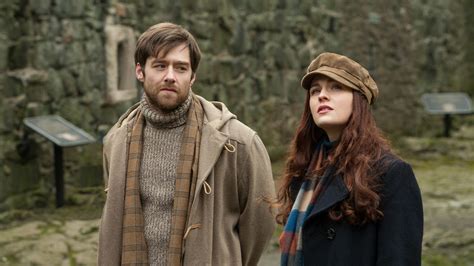
They had traveled to modern times, where Brianna fell in love with Roger MacKenzie (Rankin), a historian. (They’re shown here.) She soon learned that he could time-travel, too; eventually, they married and become major factors.
Yes, the show’s concept — based on novels by Diana Gabaldon — is a tad unusual. It starts with Claire (Caitriona Balfe), a World War II nurse, accidentally whisking back to 1743 Scotland. She falls for the heroic Jamie (Sam Heughan) and finds ways to use her strong knowledge of medicine and her flimsy grasp of history. Both end up in Revolutionary-era America; she’s sometimes been in 1968.
The series debuted in 2014, when TV wasn’t much interested in time-travel or love stories. “Romance back in that time was kind of a dirty word,” recalled producer Maril Davis. But “this is so much more. (People) crave seeing great love stories go the distance.”
And this one has gone a LONG distance — both in the scope of the story (225 years) and in production: This final season — 10 Fridays on Starz, starting at 8 p.m. March 6 — is the eighth one; production — delayed by Covid, strikes and sheer logistics — has sprawled over 12 years.
Along the way, “Outlander” has changed lives. Heughan and Balfe show up on posters and magazine covers and more. She’s had four Golden Globe nominations as best actress; he had his own reality show, “Men in Kilts.”
Another Scotsman, John Bell, found his life transforming. “I auditioned for this show when I was 18 years old …. I’d had a career as a child actor and I hadn’t worked for two years,” he said. “It was actually one of the last auditions that I had before I was supposed to go to university.”
Then came “Outlander,” rescuing him from unemployment and/or education.
Earlier, Bell had played the teen king Bain in two “Hobbit” movies. Now he’s Ian Murray (known as “Young Ian”), complete with Mohawk hairdo — “it takes about a half an hour to get it right” — and American adventures.
“I’ve always been a bit of a history geek and nerd,” Bell said. But “I had no idea just how fundamental Scotland’s part was in the founding of America.”
Gabaldon, a Latina from Arizona, hadn’t actually been to Scotland when she started the books. Her specialty was historical research, not travel.
But now the actors could do the traveling. Most of the “Outlander” scenes — including the ones set in North Carolina — use Scottish backdrops.
“It opened my eyes to Scotland,” Rankin said. “(I’ve) taken in so many incredible locations. I think sometimes you just don’t appreciate — or I didn’t — what’s kind of on your doorstep.”
Ronald Moore — who had drawn raves for his “Battlestar Galactica” reboot — led “Outlander” for the first three seasons. Matthew Roberts has been in charge for the final years, joined by Davis and others.
They’ve been free to detour from the book, but that was especially true for this final season. With some of the actors going on to other things, “Outlander” producers had to concoct an ending, without knowing how Gabaldon will end her 10th and final “Outlander” novel.
Davis says the show ends with “a really beautiful episode,” but she “cried fat, ugly tears … because it’s ending.”
So did others. “It felt like we were always saying goodbye to someone or .(to) a location or something,” Skelton said. “So there were a lot of bittersweet moments” as a12-year (or 225-year) journey ended.
“Outlander”: an 8-year, 12-year, 225-year journey
A dozen years ago, Scottish actors were buzzing about the odd project that was consuming their film industry.
“It just arrived in force and it absorbed about 85 percent of our television crew,” Richard Rankin said.
This was “Outlander” (shown here) now a familiar show — its eighth and final season starts Friday -(March 6) — but then an oddity. Its time-travel story sweeps across two centuries of adventure and romance; working in it was a logical goal for Scotsmen and others. Read more…