As cable prepares its Coppolathon, it’s time to reflect on a dazzling career,
On Thursday (July 31), Turner Classic Movies will show Francis Ford Coppola, 86, receiving the American Film Institute’s lifetime achievement award. That’s at 8 p.m. and midnight ET, alongside two Coppola films — one epic (“Apocalypse Now,” shown here) and one not (“The Rain People”).
This is a career that has weaved through the extremes — some soft porn, a couple cheapies, a tad of comedy, two musicals and some great dramas.
The AFI lists Coppola’s “The Godfather” as No. 2 on its all-time list, behind only “Citizen Kane.” It puts “The Godfather, Part II” at No. 32 — the only sequel to make the top 100.
A cynic might point out that those were in 1972 and ’74; Coppola peaked a half-century ago.
A non-cynic will praise him for constantly trying the new and the odd. Either way, it’s quite a life.
And it starts with a couple surprises: Coppola is a classic New Yorker who grew up in Queens … but he was born in Detroit. He showed (in the movie “Tucker”) a disdain for Henry Ford … but was partly named after him.
Carmine Coppola, Francis’ father, told me that the middle name was partly because the birth was in Ford Hospital and partly as a tribute to Ford.
Back then, Carmine played flute in the Detroit Symphony and was assistant director of the orchestra for radio’s “Ford Sunday Evening Hour.” He recalled Henry Ford as a pleasant chap who would chat with the musicians.
When Francis was 2, his dad became the principal flutist for Arturo Toscanini’s NBC Symphony Orchestra, in New York.
Like Martin Scorsese (now 82), Coppola was surrounded by Italian-American culture, but not fully able to participate. Scorsese had severe asthma; Coppola had polio. Both threw themselves into imagination … then became Hollywood’s prime spinners of Italian myth and legend.
At Hofstra University, Coppola brought a swirl of theater and movie projects. Then it was UCLA for a Master’s degree and a quick jump into filmmaking.
He used his editing skills to stitch together some nudie films, “Tonight for Sure” and “The Bellboy and the Playgirls.” Then he was hired by Roger Corman, a master of the micro-budget.
As Beverly Gray, a longtime assistant, told it in “Roger Corman” (Renaissance Books, 2000), Corman bought “a clumsy Russian science-fiction film on the strength of its special-effects scenes, then hired a bright young man to add monster footage and dub in new dialog.”
That was Coppola, and “Battle Beyond the Sun” (1963) was a modest start. So was “Dementia 13,” a horror film that Coppola made for $22,000, using the stars who had just finished another Corman film.
That same year brought “The Terror.” Coppola was one of several directors, Gray wrote, trying “to make sense of a plot that was virtually non-existent.”
What soon set Coppola apart was his writing. He co-wrote the Oscar-winning script for “Patton,” plus the movies “This Property is Condemned” and “Is Paris Burning?” He also wrote and directed “You’re a Big Boy Now,” a modest-budget youth film that drew strong reviews.
Coppola was hired to direct “Finian’s Rainbow,” a musical delight that keeps returning to TV each St. Patrick’s Day. Then he wrote and directed “The Rain People,” starring a former Hofstra classmate, James Caan.
(Caan told me he mostly stayed to himself while Coppola and his assistants — including George Lucas — kept talking film-buff stuff at night.)
“Rain People” drew strong reviews but weak box-office … which may have transformed Coppola’s career. He had originally turned down “Godfather”; now, in need of success, he took the job, co-wrote a new script, hired Caan, Al Pacino, Marlon Brando and others, and created a masterpiece.
Coppola’s has gone in many directions. He was producer for films by Luca (“TX1138,” “American Graffiti”), his daughter Sofia (“Virgin Diaries,” “Lost in Translation”) and others.
He removes himself from the movie world whenever possible. “Francis deeply distrusted Hollywood and lived and worked in San Francisco …. He created his own personal fiefdom, filled with murderously loyal counterculture artistic geniuses,” Rob Lowe wrote in “Stories I Only Tell My Friends” (Holt, 2011).
He would sometimes re-align with Hollywood to make a commercial film. “The Outsiders” (with Lowe, Tom Cruise and other young stars-to-be) is a prime example. So were “The Rainmaker” and “Peggy Sue Got Married.”
But that phase would pass. Coppola hasn’t made a commercial film since “Rainmaker,” 28 years ago. Last year’s “Megalopolis” failed at the box office and drew shrugs from critics.
The flops, of course, are temporary; the triumphs are part of film history. Now viewers can re-life Coppola’s career on Paramount+, on Max and on the Thursday package on TCM:
— 6 p.m. ET, a film about the 50-year history of the AFI Award; 8, the AFI tribute to Coppola; 9:15, “Apocalypse Now.”
— Midnight, the AFI tribute reruns; 1:15, a documentary about the making of “Apocalypse Now”; 3:15, “The Rain People.”
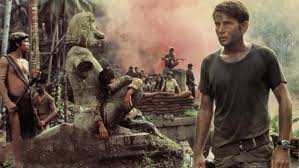
Coppola: mini-budgets, maxi-budgets, triumphs
As cable prepares its Coppolathon, it’s time to reflect on a dazzling career,
On Thursday (July 31), Turner Classic Movies will show Francis Ford Coppola, 86, receiving the American Film Institute’s lifetime achievement award. That’s at 8 p.m. and midnight ET, alongside two Coppola films — one epic (“Apocalypse Now,” shown here) and one not (“The Rain People”).
This is a career that has weaved through the extremes — some soft porn, a couple cheapies, a tad of comedy, two musicals and some great dramas. Read more…