When “The Hard Hat Riot” arrives — 9 p.m. Tuesday (Sept. 30) on PBS — it will deliver everything we expect from a great documentary.
It has two strong sides, dozens of passionate voices, plenty of conflicting values. In big and small ways, it shows the world transforming.
But the film (shown here) has one other distinction: For now, at least, it’s the second-to-last one aired by the award-winning “American Experience.”
When Congress suddenly cut off funding for public-broadcasting, we couldn’t be sure where it would impact. Definitely, it would cripple small-town radio and TV stations, causing some to fold. But what about national effects?
Now we see a big one, centering on the Boston station.
Over the years, WGBH has produced a steady stream of shows. Many have been cozy and comfy (Julia Child, Boston Pops, “Nova,” “Antiques Roadshow”); some haven’t (“Frontline”). And some have been in between, including “Masterpiece” and “American Experience.”
When the federal funds vanished, WGBH decided to suspend “AE.” Those episodes are the most expensive per-hour: Most require deep research, need to license old footage and have sparse prospects for international deals.
Over the years, “AE” has done splendid work. Its films have drawn 14 Peabody Awards (the first for a film about the Donner Party, the 14th for one about the Oklahoma City bombing). They’ve had three Academy Award nominations and 43 Emmy nominations, winning 12 times.
Recent years have brought fascinating pieces of pop history — the myth and reality about the birth of Monopoly … the backlash against disco … the “sun queen” who was a pioneer in solar energy.
During this past TV season, there were compelling looks at the birth of the American Disabilities Act and the war against smog. There were also portraits of the Polaroid inventor and of Walter White, the light-skinned NAACP chief who had moved undercover among Southern whites.
And this season? In the works were portraits of the National Highway System launched by Dwight Eisenhower … the GI Bill that propelled many people to become first-generation college grads … birthright citizenship … and Puerto Ricans. All have now been suspended.
That leaves only two projects that were basically ready:
— On Oct. 27-28, “AE” has a four-hour profile of Henry Kissinger, the master of foreign policy in the Nixon and Ford administrations. It’s from Barak Goodman, who has made Emmy-nominated films on cancer, Clinton, Scottsboro, Oklahoma City and more.
— And first, on Tuesday, is that hard-hat film, a deeply moving story.
It starts with the guys who were blue-collar workers back in 1970 New York. They’re easy to like — tough, solid, recalling the days when family was everything … including the link to a job. They went to Mass each Sunday, went to work each weekday, played hard in-between.
Then we meet the college guys, who hated the Vietnam War. Eventually, the majority of Americans would agree with them … but not in 1970.
During an anti-war demonstration, the union guys arrived in hard-hats, waving flags. The City Hall flag had been at half-mast, mourning a New Yorker killed at Kent State. They demanded it be raised to the top and cheered when it was. Then it was lowered again and violence erupted.
“The Hard Hat Riot” covers a wide scope. We meet the guy who lowered the flag; we hear a worker admit that he had opposed segregating his union (fearing family ties would be broken) and now feels he was wrong.
The film captures the intensity of us-vs.-them, worker vs. student, hawk vs. dove, privileged vs. not. And it catches the irony: The workers felt they were fighting to preserve their way of life; that way would fade anyway, as a gentrified New York shifted from manufacturing to commerce.
“American Experience” tells the story well — which it usually does. For now, however, it’s in limbo.
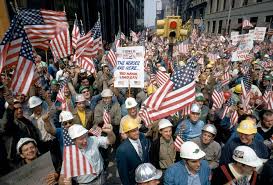
A time of tumult in 1970 … and in 2025
When “The Hard Hat Riot” arrives — 9 p.m. Tuesday (Sept. 30) on PBS — it will deliver everything we expect from a great documentary.
It has two strong sides, dozens of passionate voices, plenty of conflicting values. In big and small ways, it shows the world transforming.
But the film (shown here) has one other distinction: For now, at least, it’s the second-to-last one aired by the award-winning “American Experience.” Read more…