At 10, Jane Goodall loved the “Tarzan of the Apes” book, with one exception:
“He married the wrong Jane,” she said recently. “His Jane was a wimp.”
Most fictional women were, when Goodall read the book (1944) and when Edgar Rice Burroughs wrote it (1912). But this Jane (Goodall) didn’t fit any such stereotypes.
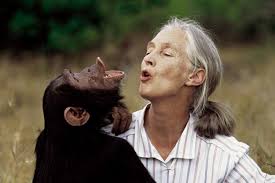
Mostly, Goodall (shown here) was known for her perpetual calmness. “I think it’s because of all the months and months I spent in the Rain Forest,” she said.
Now — after her death Wednesday (Oct. 1) at 91 — we can look back at an amazing life of working face-to-face with jungle primates. We can catch her new “Famous Last Words” on Netflix … And National Geographic documentaries, led by the 2017 “Jane” and the 2020 “Jane Goodall: The Hope,” both on Disney+ … And PBS documentaries … And her books.
(For this story, the “she said” quotes are from the Netflix show; the “she wrote” ones are from “Reason For Hope,” Warner Books, 1999.)
The Netflix one launches a fresh concept. People were told they could speak frankly, because the interview wouldn’t be shown until after their death.
That allowed Goodall to deliver what she considers her message from the grave. Amid climate change, she says: “There still is hope. Don’t lose hope.”
And it includes a blunt moment. Asked to mention people she dislikes, she hesitated, smiled and said: “I would like to put them on Musk’s space ship and send them to the planet he’s sure he’s going to discover.”
Elon Musk would be the host, she said, and the ship would include Donald Trump and “some of Trump’s real supporters,” plus Putin and Xi and more. “I’d certainly put Netanyahu in and his far-right government.”
The world has the tools to save the Earth and its climate, she said, but it also needs the will to do it. “With some of the top politicians and some of the corrupt corporations, there isn’t that will.”
Still, she said: “I truly believe that most people are decent” and that people can change. A Singapore executive told her of his transformation, after his 8-year-old daughter said she had heard he was hurting the planet: “That’s not true, is it, Daddy? Because it’s my planet.”
When Goodall was that age, World War II was at its midpoint. Her father (an engineer and auto-racer) was at war; she with her mother, sister and others, living at the estate where he had grown up.
That fit her perfectly, she wrote. “Like most children before the age of TV and computer games, I loved being outside, playing in the secret places in the garden, learning about nature.”
Her mother encouraged this — even when (at 18 months) she brought worms into her bedroom and when (at 4) she disappeared for four hours, while learning how a hen lays eggs. “They had even called the police to report me missing,” she wrote.
Goodall gave names to the trees, just as she would later name chimpanzees. But that future didn’t seem likely at first. “Girls back then couldn’t dream of anything like that,” she said.
She slid through education; “as a child,” she wrote, “I was not at all keen on going to school.” She dreamed of being England’s poet laureate and even “fantasized about becoming a martyr.”
Instead, she became a secretary — at a clinic, at a documentary film studio and at Oxford: “I experienced a good deal of the fun of university life,” she wrote, “with none of the academic burdens.”
She was invited to visit a friend whose family had bought a farm in Kenya. Goodall spent five months living at home, working as a waitress and saving her money for the trip. Then she headed to the continent she’d dreamed about since reading “Tarzan.”
When Goodall talked about her love of animals, someone there mentioned Louis Leakey, a pioneering anthropologist. She contacted him and he gave a tour of his museum, peppering her with questions. “I could answer most of them,” she said, “because I’d read just about every book on Africa.”
Soon, she was working as his secretary. She even kept a pygmy bush baby primate in his office. When people arrived, she said, “he’d jump onto the unsuspecting visitor” and urinate. “Imagine the fun!”
Leakey soon planned a trip into unknown territory, with his wife plus Goodall and another worker. During a walk one night, the two young women were confronted by a lion. One wanted to run, but Goodall convinced her to go to higher ground. “I think that evening was when Leakey decided I was the person to study chimps,” she said.
This was groundbreaking — a 23-year-old, with no college education, living among the animals. Her mother (now divorced) was required to live with her.
Goodall would soon discover remarkable things about chimps, including their ability to make tools and to forge warm relations with humans and with each other. She also saw the other side, she said. “I saw them behave in dark, brutal, aggressive ways — even a kind of primitive war.”
She saw two types of alpha males, she said. Some use sheer aggression; “others use their brains …. They last much, much longer.”
A favorite scene came when she was watching two male dung beetles, each pushing along the dung they treasured. They stopped and fought; a female promptly took their dung, added it to her own, and merrily rolled along.
Yes, Jane Goodall stared at dung beetles. She found them — and the rest of the natural world — fascinating.
She kept making pioneering discoveries, then opened her own research centers (she now has 23 of them), plus a youth program (Roots and Shoots) that’s now in 75 nations. She traveled globally, speaking about nature and climate change.
Her marriages weren’t as successful. The first ended in divorce after 10 years; in the second, she was widowed after five.
“I shouldn’t have married either of them,” she said. “Both of them were insanely jealous.”
She married out of love, she said, but “looking back, I wasn’t enough in love.” In between those marriages, there was a strong romance, but he was married and that ended.
What she thrived on is the research, the writing and her basic message: “In the dark times we are living in now, if people don’t have hope, we’re done.”
She dreamed of Africa … then triumphed there
At 10, Jane Goodall loved the “Tarzan of the Apes” book, with one exception:
“He married the wrong Jane,” she said recently. “His Jane was a wimp.”
Most fictional women were, when Goodall read the book (1944) and when Edgar Rice Burroughs wrote it (1912). But this Jane (Goodall) didn’t fit any such stereotypes.
Mostly, Goodall (shown here) was known for her perpetual calmness. “I think it’s because of all the months and months I spent in the Rain Forest,” she said.
Now — after her death Wednesday (Oct. 1) at 91 — we can look back at an amazing life of working face-to-face with jungle primates. We can catch her new “Famous Last Words” on Netflix … And National Geographic documentaries, led by the 2017 “Jane” and the 2020 “Jane Goodall: The Hope,” both on Disney+ … And PBS documentaries … And her books. Read more…