So there we were in 1984, at a Television Critics Association session.
Jac Venza, founder of PBS’ “Great Performances” series, was talking about its latest “Dance in America” special. It had “A Song For Dead Warriors,” by the San Francisco Ballet.
And, Venza told us proudly, we might be familiar with the composer, Charles Fox. He wrote the theme song for “The Love Boat.”
At this point, we promptly did what critics do. We moaned, groaned and offered a general air of derision … before Venza could continue: “And here he is: Charles Fox.”
I felt sorry for Fox, victim of a misplaced introduction. (Venza could have just as easily noted that he co-wrote “Killing Me Softly With His Songs,” drawing great approval.) But I emerged with two conclusions:
1) Always read the room and know your audience; and
2) TV critics REALLY disliked “The Love Boat.”
That comes to mind now, with that show profiled on “TV We Love,” at 8 p.m. Monday (Oct. 27) on CW. Several times, people say that critics hated it and viewers loved it. Both of those are true.
It arrived in 1977, in a tough timeslot — 10 p.m. Saturdays on ABC, opposite Carol Burnett’s terrific CBS show. “Love Boat” finished the season at No. 14 in the Nielsen ratings; Burnett was cancelled.
After that, the show moved to 9 p.m. and thrived. In its nine-season run, it was a top-10 show twice (No. 5 in 1980-81, No. 9 in ’82-83) and top-20 four more times.
And why did the critics hate it? You can analyze many things, before settling on an answer: It really was not a good show. Trying to stuff way too much into each hour, it had clumsy writing and cardboard characters.
But the formula was sort of foolproof. On a cruise, you can get quick stories about the guests and about the crew. You have romance, melodrama and more … against a backdrop of blue skies and attractive folks in swimwear.
Aaron Spelling — who at one point filled seven of ABC’s 22 primetime hours — produced the show with Doug Cramer. They filmed two pilots that ABC aired, but rejected as series. The key was a Spelling specialty — casting.
He already had three good stars — Fred Grandy and Ivan Dixon (both of whom appear often in the CW hour) and Bernie Kopell. But for the third pilot, he wanted to recast the captain and the social director.
As it happened, “The Mary Tyler Moore Shows” was finishing its seven-year run. Spelling convinced Gavin MacLeod to play Captain Merrill Stubing.
And Julie McCoy, the social director? Lauren Tewes was 22, a near-unknown who had had guest spots on Spelling’s “Vega$” and “Charlie’s Angels.” Her car almost broke down on the way to the auditions; she made it, got the role, and started filming the next day.
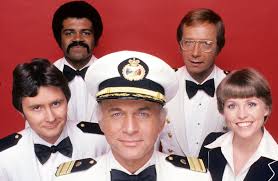
With a core cast that people liked — shown here, left to right, are Grandy, Dixon, MacLeod, Kopell and Tewes — the guests could range afar. Spelling loved including movie stars from the past — Lana Turner, Greer Garson, Ann Baxter, Ray Bolger, Stewart Granger, Ann Baxter, Carol Channing and more.
But he also had lots of young unknowns. The CW hour offers early glimpses of Tom Hanks, Michael J. Fox … even Ricky Martin, who did two episodes as a member of the Menudo group.
Mixing farce, warmth and nostalgia, “Love Boat” pieced together an audience. It drew kids and old people and others … but not, of course, TV critics.
It was “The Love Boat” or “Hate It Boat”
So there we were in 1984, at a Television Critics Association session.
Jac Venza, founder of PBS’ “Great Performances” series, was talking about its latest “Dance in America” special. It had “A Song For Dead Warriors,” by the San Francisco Ballet.
And, Venza told us proudly, we might be familiar with the composer, Charles Fox. He wrote the theme song for “The Love Boat.”
At this point, we promptly did what critics do. We moaned, groaned and offered a general air of derision … before Venza could continue: “And here he is: Charles Fox.” Read more…