Maybe we should quit grumbling about all those airline delays.
We should use that down time to create hit TV shows. That happened once.
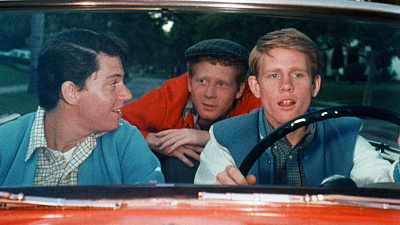
The latest “TV We Love” episode (9 p.m. Monday, Nov. 10, on CW) looks at “Happy Days” (shown here), First, let’s catch an account of the show’s birth:
“‘Happy Days’ was created at Newark Airport, when I was snowbound,” Michael Eisner said in “Beating the Odds” (Scribners, 1991). “I was there with my wife and our three-month-old baby ….
“Tom Miller, Paramount’s head of development, was with us, and I said: ‘We have nothing to do; why don’t we create a show?'”
They wrote a five-page paper, “New Family in Town,” capturing the low-stakes, 1950s life. Eisner (who worked for ABC) gave it to Garry Marshall, who turned it into a tale in the ABC/Paramount “Love, American Style.”
Ron Howard, 18, starred. “I wasn’t getting any work, because I was in that awkward period” after being a child star,” he says on the CW show.
And this idea could have died, Eisner said. ABC’s “research department had reams of paper about why the 1950s wouldn’t work.”
Then George Lucas’ “American Graffiti” reached theaters in 1973 — again with Howard in a retro story (set in 1962). It was a hit … and ABC was open to a second “Happy Days” pilot, which was shown to test audiences. “It was the highest-tested pilot I’d ever been involved with,” Eisner said.
That version kept three people from the original — Howard (right), Marion Ross (as his mom) and Anson Williams (left, as Potsie). It cast Tom Bosley as the dad, added a brother (who would later disappear). a sister, another friend (Donny Most, centerm as Ralph Malph) … and the enigmatic Arthur Fonzarelli.
He was intended to be big, imposing and Italian. Instead, TV buff Jim Colucci says on the CW show, Marshall cast Hentry Winkler — “this nice, young Jewish man, a graduate of Yale Drama School …. He was the opposite of Fonzie.”
And he was perfect. He used acting and attitude, not size, to be a TV giant.
It took a while to realize what a force he was. Fonz say a word until the end of the first episode, the CW show says; for a while, ABC had him wear a less-imposing white jacket.
But soon, a black-clad Fonzie prevailed. Arriving at mid-season, “Happy Days: finished No. 16 in the Nielsen ratings for 1973-74, one of only two ABC shows in the top-20; the other, “Six Million Dollar Man,” had debuted that same week. This was, Eisner said, “the beginning of ABC’s turnaround.”
But the ’50s novelty wore off quickly. In its second season, “Happy Days” fell out of the top-30; there was talk it might be canceled.
Marshall made drastic moves: Instead of filming the show movie-style (one camera, lots of outdoor locations), he switched to mostly using multi-cameras and a studio audience, creating a brisk, joke-filled rhythm.
That started with the final episode of the second season. As the third began, “Happy Days” finally had its own theme song; also, Richie’s family slipped to the background — with Fonzie in the foreground.
When the young actors visited the public, Howard says in the CW show, “it was like we were a boy band and Henry was the lead singer.”
Egos could have exploded. In such situations, Winkler has said, there has to be a grown-up. That wasn’t him, he said; it was Howard, nine years his junior. Descended from Oklahoma ranchers, Howard had been acting professionally since he was 5; he was the steady force at the center of the show.
For its third year, “Happy Days” jumped to No. 11. The No. 3 spot went to “Laverne & Shirley”; it had two characters from a “Happy Days” episode — one played by Marshall’s sister Penny, the other by Howard’s “American Graffiti” co-star, Cindy Williams.
For the next two seasons, those shows took turns being No. 1 and 2 in the ratings. For the one after that, they shared the top four spots with other ABC comedies, “Mork & Mindy” (also spun from a “Happy Days” episode) and “Three’s Company.” ABC dominated … and then it didn’t.
This “TV We Love” episode leans heavily on past interviews of Howard, Winkler and others. But it does have new ones with Most and two actors who arrived later, Scott Baio and Lynda Goodfriend.
Baio has a quick assessment of “Joni Loves Chachi,” the spin-off he did with Erin Moran, who played Richie’s sister. “It was a mistake, because … we didn’t really like each other.” They had dated briefly, but that imploded.
He also tells why “Happy Days” sputtered. “The show just became silly.”
Focusing heavily on Fonzie and gimmicks — including water-sking over sharks — the show stayed in the top-20 for three more years, then faded.
But “Happy Days” had propelled ABC … and lots of others.
Howard, Winkler, Anson Williams and Penny Marshall all became gifted directors and/or producers. Eisner became the head of Paramount and then of Disney, which bought ABC and (for now) has almost forgotten about situation comedies.
Some happy days emerged from a snowstorm
Maybe we should quit grumbling about all those airline delays.
We should use that down time to create hit TV shows. That happened once.
The latest “TV We Love” episode (9 p.m. Monday, Nov. 10, on CW) looks at “Happy Days” (shown here), First, let’s catch an account of the show’s birth: Read more…