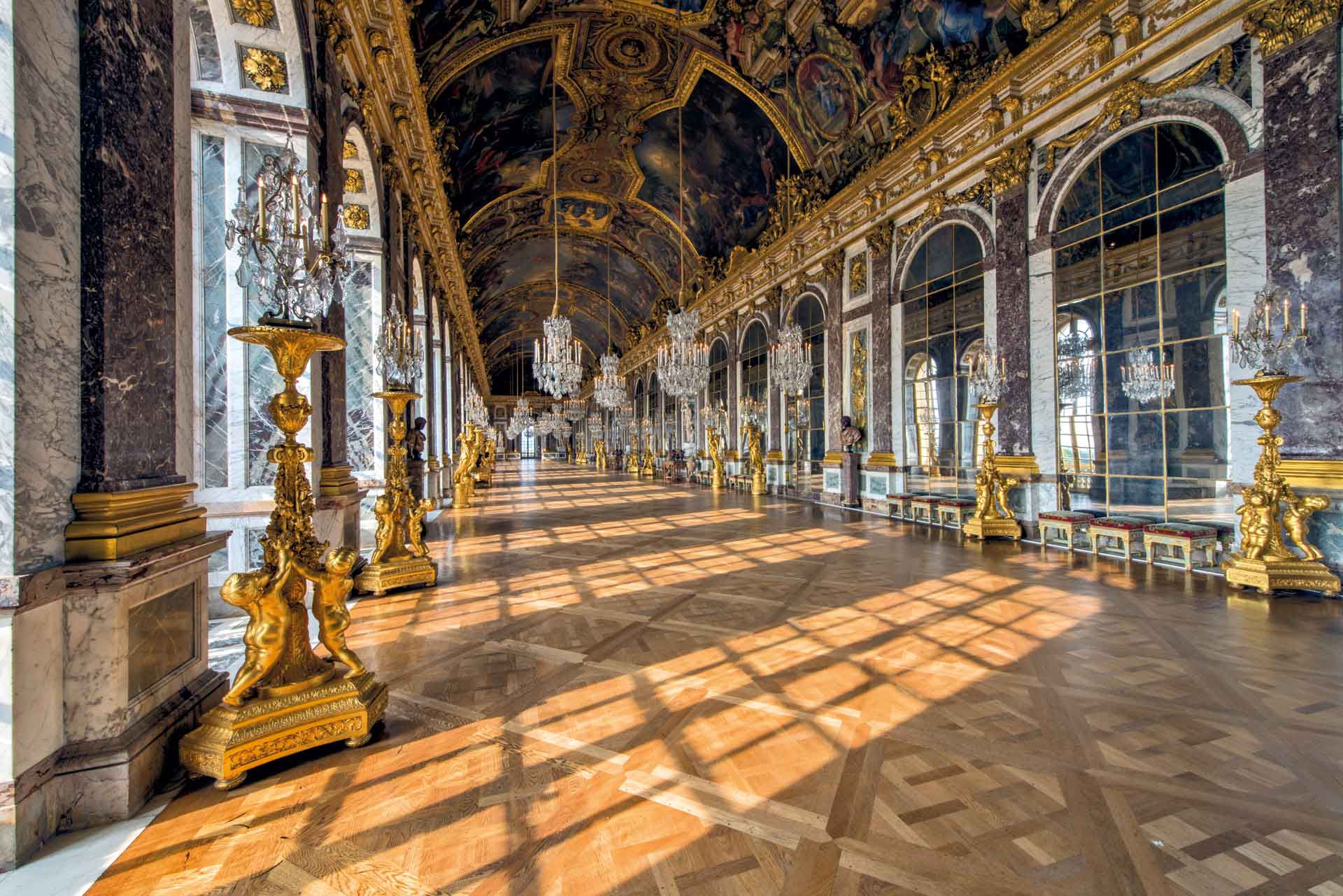
Scattered across Europe are castles from distant eras.
Some are elegant, some are ominous, all are big and maybe mysterious. We wonder what went on in there.
Now “Keys to the Castle,” a new PBS series, gives us some answers. Amid all the gold and glitter (Versailles is shown here) some people governed, some tortured, some drifted into make-believe. Two used theater set-designers to spur their illusions.
“Keys” is a four-part series that some stations will air at 8 p.m. on December Sundays. Our guide is Lucy Worsley, who was joint chief curator of England’s royal palaces for two decades, while also becoming a TV presenter. Here are the castles and the dates when some stations will air them, with details from the specials and other sources:
VERSAILLES (Dec. 6)
Marie Antoinette was a 14-year-old Austrian when she married the French prince, linking two kingdoms. Five years later, he became King Louis XVI.
Their estate, constructed a century earlier in the countryside, had 2,300 rooms. It was home to 10,000 people (including the French government); the design theme, Worsley says, was “madly gold.”
Still, there was also a mini-mansion, a mile-and-a-half away. Built for two previous women, it often became Marie’s home; Louis didn’t stay overnight.
Remarkably, Marie went further. Nearby, she had workers construct a lake and a fake hamlet. On one side was a working farm, with barn, dairy, pig sty, hen house, sheep pen and more. On the other, a non-functioning windmill was next to fake cottages that were actually a billiard room and such.
This was meant to feel like an old, rustic village … so much so that theater set-designers created the pretend signs of age and wear.
For six years, this was a place where Marie could stroll, have small parties with friends and show her children the simple life. Then came the revolution.
In the 234 years since then, Versailles has been refurbished. The hamlet has been restored four times, once with money from John Rockefeller.
DOGE’S PALACE (Dec. 13)
Long before DOGE meant (briefly) Departmenmt of Government Efficiency, the doges were the elected leaders of Italian city-states.
In Venice, a palace was built in 810 AND rebuilt in 1340, holding a massive government: The council hall, Worsley says, is 170 feet long and could hold 2,500 people.
But in Medieval times, there was less interest in parties. Worsley describes a culture of spies and counter-spies, plus a torture chamber and cells where prisoners sometimes had water up to their knees;.
Some got out — including Giacomo Casanova, the famed lover. He may be one of the only people to escape from a major prison by gondola. He fled to Paris and wrote books about his escape and his life.
Blenheim Palace, England (Dec. 20)
Some old homes have Queen Anne furniture, but this one was partly financed by Queen Anne herself.
John Churchill was a military officer, businessman (head of the Hudson Bay Company) and government official. After military triumphs, he was named the first Duke of Marlborough and given a rural estate.
Anne provided money for construction, but later stopped after her friendship with his wife soured.
What emerged has 187 rooms, Worsley says, including a china room and a gun room. It had 160 acres of lakes and needed 40 servants and fresh stacks of money.
At the time, there was a “bride broker.” She arranged rich American women to marry Englishmen, getting royal titles in exchange for cash. When Consuelo Vanderbilt married Charles Spencer, Worsley said, she-brought a dowry that was the equivalent of $100 million today.
The couple separated after a decade, but didn’t officially divorce for another 20 years. And the palace thrived.
Charles’ nephew, Winston Churchill, was born there and shared the family’s fascination with books. There are 10,000 of them in the 183-foot-long palace library, Worsley said.
The palace housed the British spy service during World War II, but was never bombed. One theory is that Hitler envisioned living there after the war. Instead, Winston Churchill gave his victory speech there, to an outdoor crowd estimated at 60,000.
Neuschwanstein Castle (Dec. 27)
Ludwig II was 18 when he became King of Bavaria. Six years later, he began building a castle that reflected his two loves — swans and Wagner.
The castle’s name translates as “New Swan Stone”; it abounded with swan designs. Bigger, perhaps, was Ludwig’s love of Richard Wagmer operas.
Rooms were designed to reflect “Lohengrin” (Ludwig’s favorite), “Parsifal” and “Tristan and Isolde.” As Marie Antoinette did, Ludwig brought in theater set-designers to get the right look. He created perfect accoustics … but no one performed there when he was alive.
Ludwig generally was alone. He lost most of his power when Bavaria was swallowed up by Austria. Dubbed “The Swan King,” “The Mad King” and “The Fairy Tale King,” he was deposed at 40 and soon died of what was called suicide.
Only after that was there a performance in the castle. It was a Wagner opera and Adolph Hitler was in the audience.