In a logical world, this Sunday would be a national holiday.
It’s the 100th birthday of NBC. More importantly, it’s the 100th anniversary of national (almost) broadcasting.
There were lots of local radio shows in 1926. But on Nov. 15, one show reached 21 cities, from New York to Kansas City. Over four-plus hours, people heard an orchestra, an opera singer, comedians and five bands.
It was hugely ambitious. Would NBC always be like this?
Not really. The next night, the new network included “Jolly Buckeye Bakers” and “Auction Bridge Lessons.” Twenty years later, when NBC’s TV network debuted, it had “Geographically Speaking,” “Esso Newsreel,” “Fight Film Filler” an “I Love to Eat.” In the years that followed, it would include a talking chimp, two talking cars and a guy who could transform into animals.
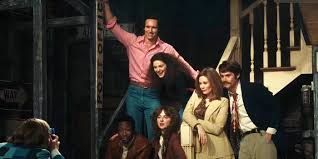
But that same network would give us “West Wing,” “Seinfeld,” “Friends,” “Hill Street Blues,” Johnny Carson and “Saturday Night Live” (shown here). All in all, it’s been a good century.
Surprisingly, NBC hasn’t set a big birthday special; it merely flashes “NBC 100” on the screen. But we can look back at Marc R0binson’s “Brought to You in Living Color” (2002, Wiley), which the network published after its 75th birthday … Leonard Maltin’s “The Great American Broadcast” (1997, Dutton), about radio history … and other sources.
The story starts with David Sarnoff, who had emigrated to the U.S., from what’s now Belarus, at age 9. A self-taught tech whiz, he played a key role in getting information about the Titanic disaster.
Four years later, in 1916, he sent a proposal to his bosses at American Marconi. A “radio music box,” he said, “would make radio a household utility in the same sense as a piano or phonograph.” It would be “especially interesting to farmers and others (away) from the cities. They could enjoy concerts, lectures, music, recitals, etc.”
The notion was rejected then, but revived four years later. American Marconi was sold to General Electric and became Radio Corporation of America.
Soon, there was a rush to launch radio stations. They were created by colleges, churches, even department stores or guys in their garages. Many, Maltin wrote, had to come up with their own, local entertainment.
“Music was performed live in the early days on radio, so stations built studios large enough to accommodate orchestras and learned how to (do) remote broadcasts from nearby auditoriums, nightclubs and hotel ballrooms.”
The flimsier projects soon faded. The number of U.S. radio stations, Robinson wrote, dropped from 1,400 in 1924 to 620 in 1926.
That’s when the bigger idea developed: Link stations to create a network with bigger shows. RCA created the National Broadcasting Company on May 19, 1926, and announced it to the public in August. On Nov. 15, it launched that first show from the Waldorf-Astoria ballroom in New York.
There was the New York Symphony, the patriotic music of the Goldman
Band and the dance bands of Vincent Lopez, Ben Bernie, George Olsen and B.A. Rolfe, plus opera singer Titta Ruffo and the broad comedy of Weber and Fields. There were even remotes from Chicago (soprano Mary Garden) and Independence, Kansas (humorist Will Rogers). The network era had begun.
By 1928, Robinson wrote, GE engineers were trying to develop a TV system. For two years, “a small Felix the Cat figurine was used as the subject. Tbe lighting was too hot for a human to tolerate.”
Others made more progress. In 1936, Germans telecast part of the Olympics and the British had a variety special, in ’38, RCA showed Gertrude Lawrence in scenes from “Susan and God.”
The next year, RCA and General Electric had TV exhibits at the World’s Fair and carried Franklin Roosevelt’s opening-night address. Ten days earlier, Sarnoff gave a televised speech of his own.
This was, he said, the birth of “an art which shines like a torch of hope in a troubled world.”
The torrch may have seemed dim. RCA’s station, WNBT, debuted July 1, 1941, with a newscast, a Dodgers-Phillies baseball game and a simulcast of the radio quiz show, “Truth or Consequences.” Five months later, Pearl Harbor came and TV was limited to four hours a week.
When the war ended in 1945, four East Coast stations combined to become NBC’s TV network. The daytime line-up, Robinson wrote, was “generally amateurish, populated with cooking shows, B movies and watch-the-artist-paint kinds of programs.”
Nighttime wasn’t much of an improvement. In 1946, NBC had eight hours a week; more than half of them involving boxing.
But ambitions remained high. Pat Weaver, who ran the network from 1953-55, once said this could be “the shining center of the home.” He added: “NBC wants America to see operas in English, the NBC Symphony, great theater performances (and) ballet.”
Sometimes, that happened. Margot Fonteyn and the Royal Ballet danced for 30 million viewers. The “Amahl and the Night Visitors” opera debuted on NBC and repeated for 16 Decembers. “Hallmark Hall of Fame” did the works of Willa Cather, William Faulkner, Arthur Miller and more.
But as the number of TV owners increased, tastes became broader. The “shining center” became the home of “My Mother the Car,” “Arthur Murray Dance Party” and “The Famous Adventures of Mr. Magoo.”
NBC would bounce back often, especially when Grant Tinker was in charge (1981-86) an used a simple formula: Hire good people and leave them alone.
That gradually led to the “must-see” era of “Friends” and “Frasier” and “Seinfeld” and more, then to highs (“West Wing”) and lows.
The current NBC has some likable comedies, but it’s propelled mostly by Dick Wolf productions (three Chicago ones, two “Law & Order ones), a few reality shows and sports.
Each Sunday, NBC’s football game rules the world — so much so that this Sunday, the network has no room for a 100th birthday party.
NBC’s first century: a fun (but bumpy) ride
In a logical world, this Sunday would be a national holiday.
It’s the 100th birthday of NBC. More importantly, it’s the 100th anniversary of national (almost) broadcasting.
There were lots of local radio shows in 1926. But on Nov. 15, one show reached 21 cities, from New York to Kansas City. Over four-plus hours, people heard an orchestra, an opera singer, comedians and five bands.
It was hugely ambitious. Would NBC always be like this?
Not really. The next night, the new network included “Jolly Buckeye Bakers” and “Auction Bridge Lessons.” Twenty years later, when NBC’s TV network debuted, it had “Geographically Speaking,” “Esso Newsreel,” “Fight Film Filler” an “I Love to Eat.” In the years that followed, it would include a talking chimp, two talking cars and a guy who could transform into animals.
But that same network would give us “West Wing,” “Seinfeld,” “Friends,” “Hill Street Blues,” Johnny Carson and “Saturday Night Live” (shown here). All in all, it’s been a good century. Read more…