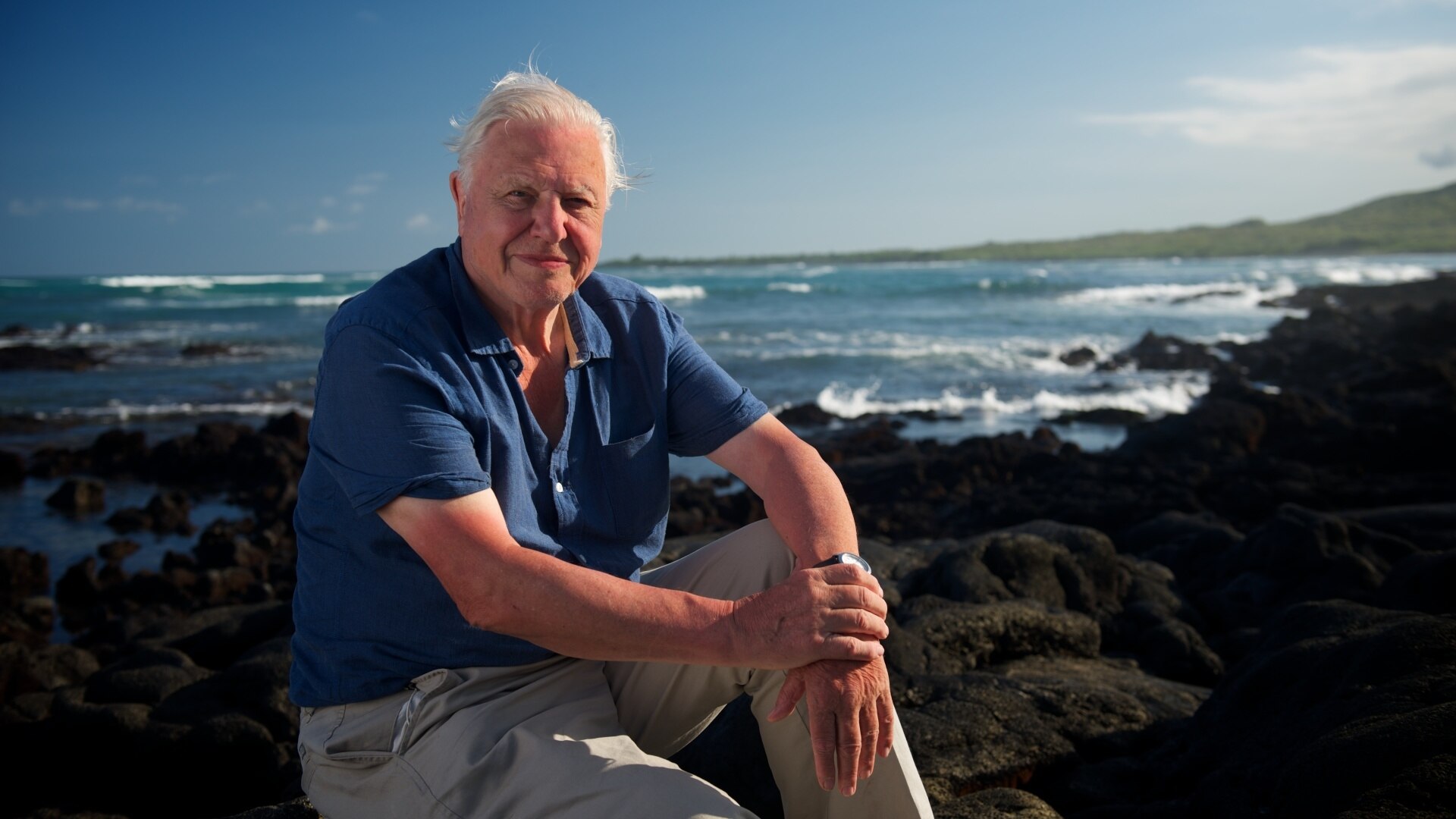
David Attenborough’s first century has been quite splendid or rather tragic.
The good news: Attenborough — who turns 100 on Friday (May 8) — revolutionized the way we see nature on TV.
“People had never seen a pangolin on television,” he wrote. “They had never seen a sloth. We showed them the largest lizard … and, for the first time, birds-of-paradise dancing in the New Guinea forest.”
And the bad? During his century, he wrote, nature has struggled. “This is the true tragedy of our time: the spiraling decline of our planet’s biodiversity.”
Now come ample chances to survey both extremes:
— At 8 p.m. Wednesday — two days before the birthday — PBS has “Life on Earth: Attenborough’s Greatest Adventure.” It views the three-year effort to film the “Life on Earth” series.
— On Saturdays (including the day after his birthday) there are daytime marathons on BBC America.
— And any time, a rich assortment of his films are on streaming services.
(At the end of this story is a sampling, plus the books that are quoted here.)
All of this centers on a guy who seems to blend both jolliness and sophistication, as if Santa Claus had gone to Cambridge.
Indeed, his older brother Richard did play a believable Santa in the “Miracle on 34th Street” remake. And David did graduate from Cambridge. But the story starts well before that.
The academic instincts are logical, because Attenborough’s father was head of University College in Leicester. That’s now a school of almost 15,000 students, in a city of almost 400,000. But for a lad, things were more rural.
Yes, his big brother obsessed on a community theater. “He persuaded me every now and then to join him and speak a couple of lines in walk-on parts, (but) my heart was not in it.”
It was further away, starting in pre-teen years. “It wasn’t that unusual for a boy my age to get on a bicycle, ride off into the countryside and spend a whole day away from home. And that is what I did. Every child explores — just turning over a stone and looking at the animals beneath.”
That included pre-historic remains. “I reveled in the thought that the first human eyes to gaze upon it were mine.”
He majored in natural sciences at Cambridge, spent two years in the Navy, then in 1952 became a trainee producer at BBC.
Back then, nature programming consisted of simply bringing hesitant animals into the studio, where a host would show them to viewers.
“They regularly relieved themselves on the doormat or, with luck, over his trousers. Occasionally, they escaped and had to be fielded by one of the uniformed zookeepers lurking in the wings.”
But everything changed when a Belgian couple showed footage from Kenya. That became the “On Safari” series and Attenborough decided: “It should be possible to combine the two style in one program.”
“Zoo Quest” was born. Attenborough went to Sierra Leone with a young Czech cameraman and Jack Lester, a curator at the London Zoo. Viewers would see an animal captured in the wild … then see it up-close in the studio.
After the first episode aired in 1954, however, Lester was hospitalized. “Someone had to take his place, The head of television instructed me to do so. ‘You are on staff,’ he said, ‘so there will be no extra fee.'”
It was his debut as an on-air personality. “I was instructed to leave the control gallery and … stand in the studio, grappling with the pythons, monkeys, rare birds and chameleons that the expedition had brought back.”
Lester re-joined for the second trip, to British Guiana, but had apparently contracted a tropical disease. He died at 47.
“Zoo Quest” visited India, Paraguay, Madagascar and more. “The 1950s were a time o great optimism …. Technological innovation was booming, making our lives easier, introducing us to new experiences. The future was going to be exciting and bring everything we had ever dreamed of.”
Attenborough finally ended the series in 1963 and soon started a fresh arrangement — splitting his time between producing TV shows and studying anthropology at the London School of Economics. “It seemed a marvelous arrangement — but it didn’t last long.”
In ’65, he was put in charge of the almost-new BBC2. Attenborough would lead a wildly innovative channel, ranging from Monty Python to “Ascent of Man.” He became program chief for both channels, but his contract let him occasionally do expeditions.
In New Guinea in 1971, he woke up and saw a group of small (under five-foot) and nearly naked tribesmen. “I had a vision of how all human beings had once lived — in small groups that found all they needed in the natural world around them …. A few days later, I was back behind my desk.”
When another promotion loomed, Attenborough resigned. “I had now been an administrator for eight years and that, I thought, was enough.”
He did some more nature films, then launched his most ambitious project.
“Life on Earth” visited 30 countries in three years and filmed at least 600 animals. Attenborugh traveled 50,000 miles; his crew totaled 1.5 million.
That’s the project profiled in Wednesday’s PBS special. Attenborough swept away all the dark myths about orangutans, He communed with them; in a surprise, two young ones sat on his face.
The 13-episode “Life on Earth” debuted in 1979. It was seen by 15 million people in the United Kingdom and 500 million worldwide.
Attenborough has been busy ever since, narrating (and sometimes producing and writing) nature films. Honors have poured in.
He’s received honorary degrees from 32 British schools. He’s been the namesake for more than a dozen species of plants and animals … and for one high-tech research ship.
(When a poll was taken to name the ship, the winner was “BoatyMcBoatface.” That name was, instead, given to a small, robotic sub; the sleek ship became the RRS Sir David Attenboropugh.)
With the improved technology, his films have gone to the Arctic and Antarctica. They’ve also gone deep underwater, as seen on Disney+’s “Oceans,” BBC America’s “Blue Planet” and more.
“Underwater cameras have become smaller and smaller and now they can record hours of material before they need reloadig. They are so sensitive that they can record pictures deep under the water, far beyond the reach of the sun’s rays….There is virtually no part of the seas that we cannot explore.”
But as technology thrives, nature struggles. Attenborough compared 1937 (when he was 11, roaming the countryside) to 2020: The global population went frrom 2.3 billion to 7.8 … wilderness went from 66 percent of the planet to 35 … carbon in the atmosphere went from 280 parts per million to 415.
“Our impact is now truly global,” he wrote. “Our blind assault on the planet is changing the very fundamentals of the living world.
He praises the African countries that preserve natural areas. And he points to Pripyat, the city of 50,000 that was abandoned after the Chernobyl explosion: “We are all citizens of Pripyat now. We live our comfortable lives in the shadow of a disaster of our own making.”
That’s the dark side of his lifetime; the light side is what he’s shown us. As Hayley and John Rocco wrote:
“Through David, we met gorillas high up in the mountains of Africa. We played with penguins on icebergs in Antarctica. We cuddled with sloths in the rain forests of South America. And we listened to the songs of humpback whales in the South Pacific.”
In other words, he’s had a splendid century.
Quotes in this story are from:
— “Adventures of a Young Naturalist,” 2017, Quercus;
— “A Life on Our Planet, 2029, Hachette;
— And, briefly, two youth books: the Roccos’ “Wild Places,” Putnam, 2024; Attenborough’s foreword to “”Our Blue Planet,” Simon & Schuster, 2020.
Finding Attenborough:
— Wednesday, May 6: “Life on Earth: Attenborough’s Greatest Adventure,” 8-9 p.m., PBS.
— Saturday, May 9 (the day after his 100th birthday): A sampling of his hours in the “Planet Earth” series and beyond. That’s from 6 a.m. to 6:30 p.m.; it includes 12 hours, from eight series. The channel also has his films on many Saturdays during the daytime plus early-mornings on weekdays; that includes 6-8 a.m. on Friday, his birthday.
— Any time, on streaming channels. Many of his films are on HBO Max, Britbox or PBS outlets, but there are other key ones. Alongside their own rich collections of nature films, Apple has the amazing Covid-era film “The Year Earth Changed” and Disney+ and Hulu have the lush, 2025 film “Oceans.”
the lush, 2025 film “Oceans.”