Staring at movies and TV shows, we’re used to this:
A disaster has started; people promptly shift into another gear. They panic, push, shout, scream and generally misbehave.
Is this realistic? “We do see panic in some emergencies,” Sarita Robinson said. “But not as often as portrayed.”
She’s studied such things for 30 years and has the academic credentials to prove it. She’s ponders disasters, new and old — in one case, very old: She’s in Tom Hiddleston’s “Pompeii: Out of Time,” a fascinating documentary (shown here), from 8-11 p.m. Wednesday (July 22) on the National Geographic Channel.
At the core is Hiddleston, a British actor and history buff, known to moviegoers as Loki (the Norse-god trickster) and to PBS viewers for Shakespeare and Wallander tales. And popping in are experts on science and survival and such.
“We have what we call ‘cognitive empathy,'” Robinson said. “He has emotional empathy. He really connected on a human level.”
They focused on three real-life Pompeii people and their possible outcomes, but they also pondered the masses, in disaster mode.
Did they crash and smash around, like movie characters? Some probably did. Studies, Robinson said, show that 10 or 15 per cent are “what I call the headless chickens, They just sort of run around, creating chaos.”
But almost as many people, she said, “stay cool, calm and collected. About 10 percent of people make really good decisions.”
That leaves the vast middle, which may include you and me.
People often speak of the “fight or flight” reactions, but Robinson adds a third “F” — “freeze.”
A few people are completely immobilized (“I call it cognitive paralysis,” she said) and many others hesitate. They’re “sort of stunned and bewildered and they tend to mull around and not do very much.”
It’s not easy to predict who will do what. Robinson finds no difference by sex, but some by age. Kids usually follow their parents’ instructions, older people are fairly good at following a leader; in between are the extremes.
It does help, she said, if you’ve been in previous crises, real or in training simulations. “You’re not having to generate those behaviors from scratch.”
But for the people of Pompeii, in the year 79, this was all new.
They would have heard the rumblings of Mount Vesuvius, Robinson said. “There’s a warning, and then people go on with their normal daily activities” — just as many of us do when we first hear a tornado siren.
Then the ash descended, in — at first — a slowly evolving crisis. “It is an event that lasts a whole 24 hours, with things getting progressively worse. And then we have this blast.”
In a city estimated at 10,00 to 20,000 people, some fled by boat; others ducked under cover. Eventually, everything was buried; it’s been uncovered now, with more than 1,000 bodies found.
“What’s so unique about Pompeii is the fact that everything is preserved,” Robinson said. “You can walk on the streets. You can look at the mosaics. You can sit in the bars and imagine what it was like.”
Her passion for disaster-behavior goes back to seeing “The Poseidon Adventure” on TV in her early teens. “I just loved that movie. I saw it at a really impressionable age.”
The film reached theaters back in 1972, with Gene Hackman leading a handful of survivors of a capsized ship. Robinson was most intrigued by the contrast between people who survived and those who didn’t. She’s followed that in other disaster films and in sometimes-goofy zombie ones. “Shaun of the Dead” (2004), she said, is “an amazing movie.”
Unlike many movie fans, Robinson also became a scholar. She got her doctorate at Lancaster University in her native England, studying “Cognitive and Neuroimmune Factors in Human Survival.” She taught at the University of Lancashire in Preston and, during the pandemic, became an associate dean.
This summer, she shed her deanly duties, to focus on researching, lecturing, consulting and such.
There is, of course, a lot to research. We have all sorts of new crises and we’re still figuring out Pompeii.
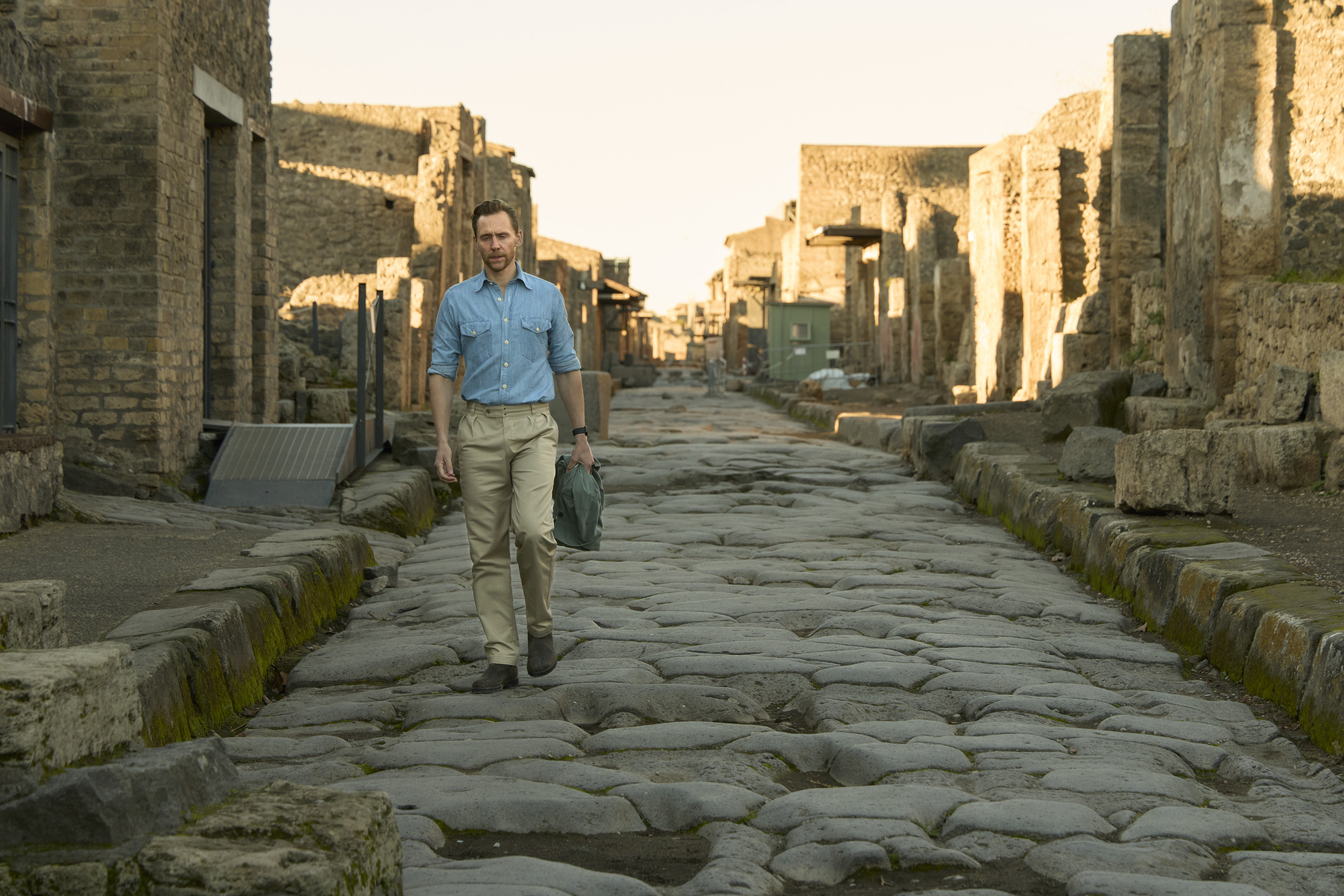
Tom Hiddleston walks through the streets of Pompeii. (National Geographic/Paolo Verzone)
From Pompeii to Poseidon: surviving disasters
Staring at movies and TV shows, we’re used to this:
A disaster has started; people promptly shift into another gear. They panic, push, shout, scream and generally misbehave.
Is this realistic? “We do see panic in some emergencies,” Sarita Robinson said. “But not as often as portrayed.”
She’s studied such things for 30 years and has the academic credentials to prove it. She’s ponders disasters, new and old — in one case, very old: She’s in Tom Hiddleston’s “Pompeii: Out of Time,” a fascinating documentary (shown here), from 8-11 p.m. Wednesday (July 22) on the National Geographic Channel. Read more…