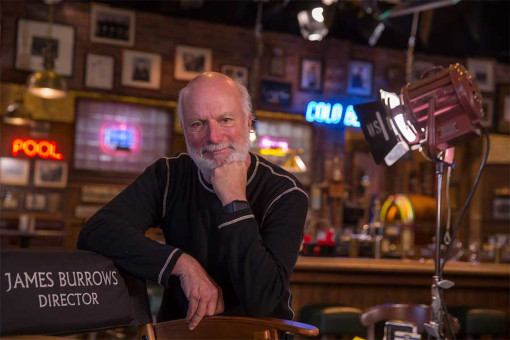
James Burrows (shown here), who died Friday at 85, was the master of TV comedy.
His work sprawled from “The Mary Tyler Moore Show” to the”Big Bang Theory” pilot and beyond. He propelled the “must-see” age of “Friends” and “Frasier” and such. He did it all.
Well, almost all. “I passed on both ‘Seinfeld’ and ‘Designing Women,'” he wrote. “I didn’t see the potential of either at the time. It happens.”
But mostly, he saw potential and expanded it. He was “one of the great comedy directors in television,” wrote Brandon Tartikoff, the former NBC chief. He was “the most successful director in television comedy — ever,” wrote Warren Littlefield, Tartikoff’s successor.
He won 11 Emmys and was nominated 47 times. He directed more than 1,000 episodes, including atg le4ast 75 pilots that became series. And he stayed with some of them, especially “Taxi,” “Cheers” and “Will & Grace.”
As Glen and Les Charles, his “Cheers” partners put it: “He’s simply become the greatest director of comedy in television history.”
He mastered the medium, they said, without any of its usual skills. “He couldn’t act his way out of the rain; couldn’t write, sing, dance or play an instrument with any distinctive ability.”
Well …Burrows did have one performing skill. He was, sort of, an opera star.
When he was in 6th grade, two people came to his school in New York City, looking for kids who could carry a tune. Burrows became one of 30 members of the Metropolitan Opera’s children’s chorus, getting $3 per performance.
“The opera was mesmerizing for me,” he wrote. “The music, the costumes, the pageantry enthralled me …. This was a new and exciting world.”
That helped shape his early years. “I grew up in the theatere,” he wrote, “learning and developing skill sets I never realized would give me a unique edge as a sitcom director.”
Theater was a natural for him. He grew up in New York, where his dad (Abe Burrows) was a writer who won a Pulitzer Prize (“How to Succeed in Business Without Really Trying”) and would have won another (“Guys and Dolls”), if not for the blacklist.
So Burrows started in theater, drawing some praise — June Allyson, alas, proclaimed that “the man has no talent whatsoever” — and mixed success. Eventually, he was stage manager for a musical version of “Breakfast at Tiffany’s,” starring Mary Tyler Moore and Richard Chamberlain.
“It was the most excruciating show I’ve ever watched,” he wrote, adding: “There were hoots and hollers from the audiences. Mary came offstage and fell into my arms after every performance, in tears.”
The show floundered in Philadelphia, had four preview performances on Broadway and closed without officially opening. At its wake, Burrows sat with a sobbing Moore for three hours, until her husband Grant Tinker flew in.
That was in 1966. Tinker and Moore went on to create “The Mary Tyler Moore Show” in ’70 and their company, MTM, launched others, including “The Bob Newhart Show,” in ’72.
By then Burrows was directing dinner-theater in Florida and wrote a letter to his old friends. “He wanted to make the transition to television,” Tinker wrote. “I told him I’d pay him $200 a week to watch other people direct.”
So Burrows watched “Newhart Show” rehearsals — at first, high up in the bleachers, then gradually moving to a close-up seat.
He observes intensely and doesn’t happen to have a cheery comedy face. If you were casting him, it would be as a stern professor, an angry agent (which he played once on “Rhoda”), a hanging judge … or maybe as Sam, the Muppets’ bald eagle.
After four weeks, Tinker wrote: “Bob Newhart told the show’s producers, ‘Get that guy out of here. He makes me nervous.'”
So Tinker sent him to the “Mary Tyler Moore Show” set to observe his best director, Jay Sandrich. “Burrows was a quick study — a born director.”
Sandrich became Burrows’ mentor, said Bob Broder, who became the agent for both. “While Jay was a star, Burrows is, by any metric, a supernova.”
At the MTM company he directed two episodes for Betty White’s show, four for Moore’s, four for Tony Randall’s, 11 for Newhart’s and 19 for “Phyllis.”
He also worked with other companies. He did eight episodes of “Laverne and Shirley” and found his home with “Taxi.” There, he did, 75 of the 114 episodes (including the pilot) … and met the Charles Brothers.
Earlier, Burrows once said, he had wanted to cast young Ted Danson as the star in the “Best of the West” pilot film. He was overruled, but got his chance when William Devane flubbed his “Cheers” audition. Danson got the role and NBC got a hit show … eventually.
When Tartikoff took over at NBC (with Tinker soon becoming his boss), the network was wobbling. “NBC was dead last,” Burrows wrote, adding: “The joke was that in a three-way race, NBC was No. 4.”
“Cheers” had trouble getting 20 percent of the TV audience. Tartikoff sent notes of encouragement and asked, “Would you want to live in a world where ‘Cheers’ only gets a 19 share.?”
At one point, he did consider canceling it, but Tinker asked, “Do you have anything better?” He didn’t; then “The Cosby Show” nudged viewers to NBC. “Cheers” ran for 11 seasons — seven in the Nielsen top-five and one at No. 1.
Burrows stayed with the show and with the first three years of its “Frasier” sequel. By then he was scurrying through many shows, especially doing pilots. That’s when “Friends” arrived.
“It was late in the 1994 pilot season,” he wrote, “and I had already committed to four other projects. I had a good sense about ‘Friends’ and knew two things immediately: One, I didn’t have time to direct it; and, two, I had to direct it.”
He did the first four episodes and 15 overall, propelling the cornerstone of NBC’s “must-see” era. A pattern emerged: Each “pilot season,” he was deluged with about 20 projects. He chose six; most became series.
That clout became crucial for “Will & Grace.”
This was new turf, centering a show on two friends, one gay and one straight. Tartikoff and Tinker had left by then and Don Ohlmeyer (head of NBC’s West Coast division) had doubts. Littlefield’s solution, reporter David Wild wrote, was to call Burrows, giving the show “a powerful friend and collaborator.”
Burrows stuck with the show, through the original eight seasons (getting as high as No. 9 in the annual ratings) and the three-season reboot. Along the way, he nudged viewers into modern times.
Throughout his career, Burrows made what Tinker called “audience shows” and many called “multi-cams.” They had three cameras at first, then four or more, allowing the show to be done before a studio audience.
“In single-camera, you only have to make the writer laugh,” Burrows wrote. “In multi-camera, you have to make the audience laugh.”
The written word is the crucial part, he said. As the son of a comedy writer, he stuck to that. “My job is to protect the writer’s vision.”
But he also nurtured performances. The Charles Brothers called him “the actor whisperer.”
Actors described the way he would stare at a rehearsal intently, then add the one thing — a physical gag, a verbal nuance — that made it work.
“There’s never a doubt who’s in charge,” the Charles Brothers wrote. “Yet within the order he maintains, he makes space for people to feel comfortable, to experiment and create.”
It’s an odd thing to witness, Broder said. “When you watch Jimmy shoot a show, he’s fascinating. He’s never watching; he’s listening. He’ll walk up and down behind the cameras, and all of a sudden he’ll kick a camera dolly to change the angle. He has a quad split in his head. He knows what each camera is seeing.”
And he stayed cool, the Charles Brothers wrote. “We’ve never seen him lose his temper, though we have seen him want to…. He’s supernaturally patient, calm when everyone around him is pounding on panic buttons.”
Burrows attributed that to the fact that his parents divorced when he was 8. “Because I didn’t have that stability growing up, I’ve tried hard to provide stability with family, friends and colleagues. “My hypersensitivity made me a good read of people and talent, quicker to sense and manage tension.”
So he kept molding pilot films that became successful series. That included “Caroline in the City,” “Dear John,” “Dharma & Greg,” “The Neighborhood,” “NewsRadio,” “Night Court,” “Roc,” “3rd Rock From the Sun,” “2 Broke Girls,” “Wings” and several other shows from “Big Bang” producer Chuck Lorre — “Two annd a Half Men,” “Mike and Mollie” and “B Positive.”
He was married twice and divorced once, with three daughters. The marriages were at mid-life and beyond, as was his bar mitzvah. “The Charles Brothers,” he wrote, “said that I was the only man they knew who was bar mitzvahed at 47 and lost his hair at 13,”
That hair-loss gave him the bald-eagle look. Coupled with his intensity, it helped frighten Newhart and propel Burrows toward Sandrich and a mastery of TV comedies.
Sources for this story
“Directed by James Burrows” (2022, Ballantine), by Burrows; includes the Charles Brothers and Allyson quotes.
“The Last Great Ride” (1992, Random House), by Tartikoff.
“Tinker in Television” (1994), Simon & Schuster), by Tinker.
“Top of the Rock” (2012, Doubleday), by Littlefield; includes the Broder quotes.
“The Showrunners” (1999, HarperCollins), by David Wild.